Field NotesStone stories
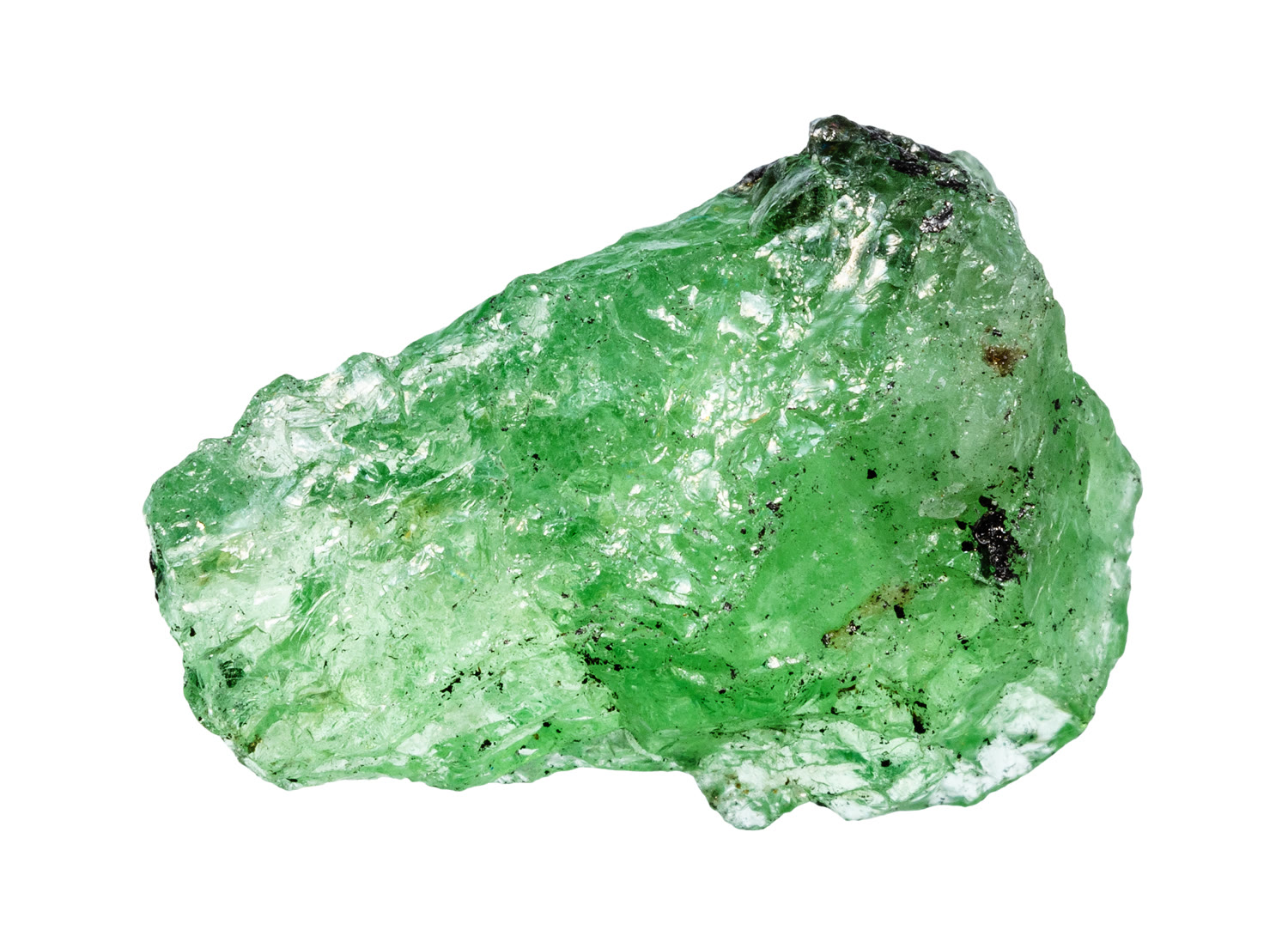
Tsavorite, the green that is not emerald
Discovered in 1967, named by Tiffany, brighter than emerald and often purer. But it is not emerald, and we do not sell it as one.
In the world of gems, green has belonged to emerald for four thousand years. Then, in the late 1960s, an alternative arrived that beats it on several objective measures. In 1967 the geologist Campbell Bridges found crystals of green garnet of a saturation never seen before in the Taita-Taveta area, on the border between Kenya and Tanzania. 1 It took nearly a decade for the stone to reach the market: in 1974 Tiffany & Co. launched it, and its president Henry Platt named it tsavorite, after Tsavo National Park. 1
Why it shines more
The comparison with emerald is not a provocation, it is arithmetic. The refractive index of tsavorite, around 1.74, is higher than emerald’s, between 1.565 and 1.602: more light comes back, the stone looks more alive. 2 And then there is purity. Emerald almost always carries its jardin, the tangle of fractures and inclusions that is part of its identity; tsavorite, instead, often comes eye-clean.
Emerald hides its garden of inclusions. Tsavorite, very often, has nothing to hide.
A colour that exists in one place only
Grossular garnet, on its own, is nearly colourless. It turns that green only when atoms of vanadium, and partly chromium, enter the structure in place of aluminium, and to do so they need very precise conditions: rocks rich in vanadium, high-temperature metamorphism, a rare chemical environment. The rocks of the Mozambique Belt, in the Taita-Taveta block, meet them almost by themselves. 3 That is why gem-quality tsavorite exists only in East Africa: it is not a lack of exploration elsewhere, it is planetary chemistry that happened in a single place.
The truth we tell
None of this makes tsavorite an emerald, and here we stop with precision. Tsavorite is a garnet, not a beryl: it has another chemistry and another history, and we never sell it as emerald. In the same way, tanzanite is not a stone of the Kenyan Rift: it comes from Merelani, in Tanzania, the world’s only source since 1967. 4 Kenya’s green already has a name of its own, and it needs to borrow no other.
Sources
- 1Bridges’ discovery (1967) and Tiffany/Platt naming (1974): Smithsonian — National Gem Collection.
- 2Refractive index of tsavorite and emerald: GIA — Tsavorite.
- 3Vanadium chemistry and the Mozambique Belt (Taita-Taveta): Crystals 2025 (MDPI).
- 4Tanzanite, sole source at Merelani in Tanzania: GIA — Tanzanite.